Multivitamins and Biological Aging: What the Headlines Don't Tell You

Your content goes here.

Multivitamins and Biological Aging: What the Headlines Don't Tell You

By Tony Ruggia | I AM LONGEVITY | Nutrition | November 26, 2026

A scientific study published in Nature Medicine examined whether taking a daily multivitamin or cocoa extract could slow down biological aging in older adults. The researchers followed 958 people for two years, using five different biological aging tests to determine whether either supplement made a difference. The results appear encouraging at first. Two of the five tests suggested that people taking a multivitamin were aging slightly more slowly than those taking a placebo. However, when we look more closely at the actual numbers, how the researchers examined their results, what they did not measure and the commercial relationships disclosed in the study, a more complicated picture begins to emerge.

Did these people actually age more slowly, or did taking a multivitamin simply change the results of two blood-based aging tests?

How Was the Study Conducted?

The research was part of a much larger scientific investigation known as the COSMOS trial, which originally involved 21,442 adults in the United States. The larger trial was designed to examine whether taking multivitamins or cocoa extract could help protect people against cancer and cardiovascular disease. For this particular investigation, the researchers examined 958 participants with an average age of approximately 70 years. Blood samples were collected at the beginning of the study, after one year and again after two years.

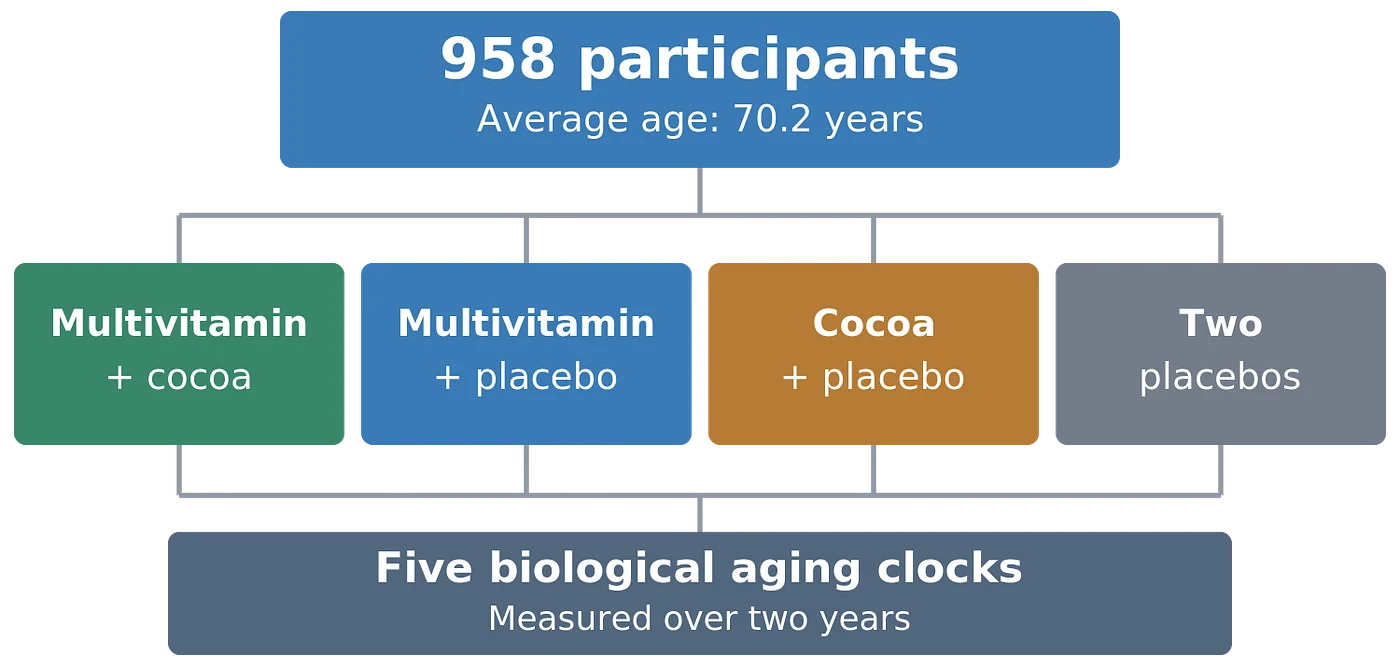
The participants were randomly assigned to one of four groups. Some received a multivitamin, some received cocoa extract, some received both, and others received inactive pills known as placebos. Neither the participants nor the researchers conducting the trial knew which treatment the participants had been assigned. This is generally considered a strong way to conduct scientific research because it reduces the chances of people's expectations influencing the results. The study design is illustrated in Figure 1.

Figure 1. How the researchers examined the effects of multivitamins and cocoa extract on biological aging.

The multivitamin used in the study was Centrum Silver. The cocoa supplement contained 500 milligrams of cocoa flavanols, including 80 milligrams of a natural substance called epicatechin. Both supplements were supplied by commercial companies, something that will be discussed later in this article. The main details of the study are presented in Table 1.

Study characteristics Details
Participants 958
Men 476
Women 482
Average age 70.2 years
Study duration Two years
Multivitamin Centrum Silver
Cocoa flavanols 500 mg daily
Epicatechin 80 mg daily
Biological aging clocks Five
Samples examined Blood

Table 1. Main characteristics of the biological aging investigation within the COSMOS trial.

What Are Biological Aging Clocks?

There is a difference between how many years someone has been alive and how well their body is functioning. Two people can both be 70 years old, yet one may still be physically active and independent while the other struggles to walk, climb stairs or perform everyday activities. Their actual age is the same, but their physical condition can be very different.

Scientists have developed various tests in an attempt to measure biological aging. Some of these tests examine tiny chemical changes that occur on our DNA. These changes are known as DNA methylation, and they can influence how our genes work without changing the DNA itself. By examining patterns in these chemical changes, researchers can calculate an estimated biological age or rate of aging. However, not all biological aging clocks measure the same thing. Some were originally developed to estimate how old someone is, while others were designed to estimate the risk of disease and death. Another type attempts to estimate how quickly the body is deteriorating.

The researchers used five different clocks in this study, as shown in Table 2.

Biological aging clock What it was designed to estimate
Horvath Age based on DNA changes
Hannum Age based on DNA changes in blood
PhenoAge Age-related health and mortality risk
GrimAge Mortality risk
DunedinPACE How quickly biological aging is progressing

Table 2. The five biological aging clocks examined in the study and their general purposes.

The important thing to understand is that these tests provide estimates. They do not directly measure every part of the human body or everything that happens to us as we grow older.

What Did the Researchers Actually Find?

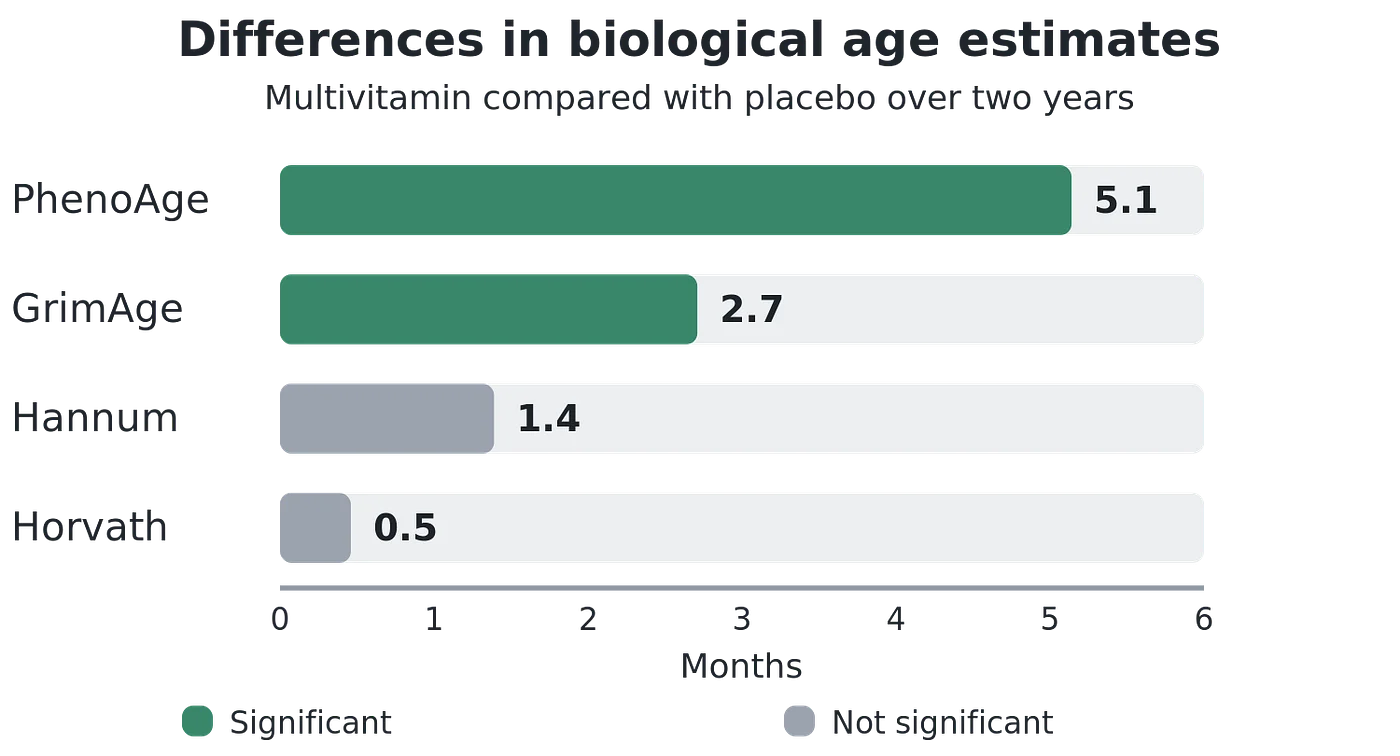
After two years of taking a daily multivitamin, the participants showed statistically significant improvements in two of the five biological aging clocks. The two clocks were PhenoAge and GrimAge. The other three did not show significant improvements when the multivitamin group was compared with the placebo group.

According to PhenoAge, taking a multivitamin reduced the yearly increase in estimated biological age by approximately 0.214 years. According to GrimAge, the difference was approximately 0.113 years. Over two years, these differences correspond to approximately 5.1 months and 2.7 months, respectively, as shown in Figure 2.

Figure 2. Estimated two-year differences in aging-clock readings, calculated from the reported yearly changes. DunedinPACE is not included because it measures aging in different units.

These numbers need to be understood correctly. They do not mean that the participants became five months younger, nor do they mean that the participants will live five months longer. In fact, the aging clocks that estimate age in years continued to increase in both the multivitamin and placebo groups. The difference was that two of those clocks increased slightly more slowly among people taking the multivitamin. That is what the researchers found.

How Small Were the Improvements?

When scientists conduct a study, they are usually interested in two things. First, they want to know whether the results are likely to be genuine rather than simply occurring by chance. Second, they want to know whether the difference is large enough to actually matter. These are two very different questions.

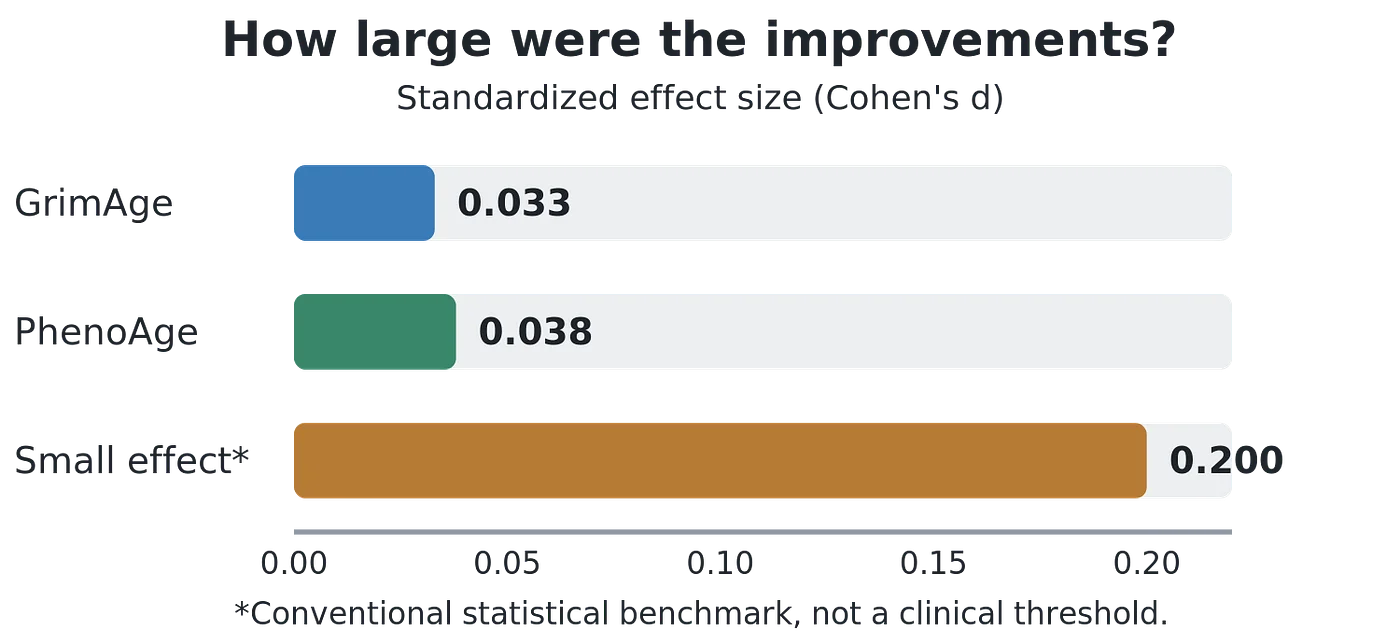
A study involving hundreds or thousands of people can sometimes detect extremely small differences between groups. Those differences may be statistically significant without necessarily being large enough to make a meaningful difference in someone's everyday life. The researchers used a measurement called Cohen's d to describe the size of the improvements. This allows scientists to compare the size of effects even when different tests use different measurements. The reported effect sizes were approximately 0.038 for PhenoAge and 0.033 for GrimAge.

To put these numbers into perspective, an effect size of 0.2 is traditionally considered small, although what matters clinically depends on the particular measurement and outcome. Figure 3 illustrates the difference between this conventional benchmark and the results reported in the study.

Figure 3. The reported improvements were considerably smaller than the conventional benchmark for a small statistical effect.

The improvements detected in this study were extremely small. Whether changes of this size will make any noticeable difference to how people age remains unknown.

Who Benefited the Most?

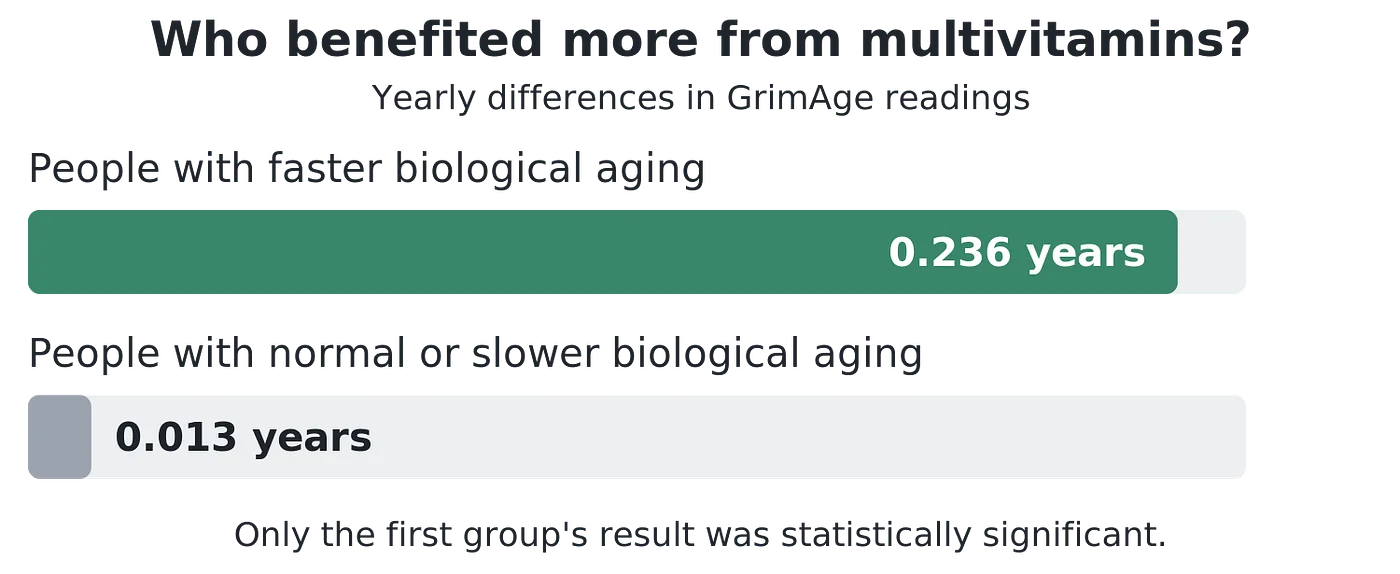
One of the more interesting findings was that the multivitamin appeared to work better among people whose biological aging clocks already suggested that they were aging faster than expected. According to GrimAge, participants in this group experienced a considerably larger improvement than those whose initial results suggested that they were aging normally or more slowly.

Why might this have happened?

The researchers suggest that some of these people may have had lower levels of important vitamins and other nutrients. Taking a multivitamin may have helped improve their nutritional condition, which could have influenced their biological aging test results. The researchers examined blood levels of several nutrients in a smaller group of 166 participants. They found indications that people with lower nutrient levels tended to have higher biological aging readings and that improvements in nutritional levels were associated with improvements in those readings. However, this does not establish that nutritional deficiencies were responsible for all the observed changes. The difference between the two groups is illustrated in Figure 4.

Figure 4. The multivitamin produced a larger difference in GrimAge readings among participants whose initial results indicated faster biological aging.

There is nothing particularly surprising about the possibility that someone who is not getting enough essential nutrients may benefit from taking a multivitamin. Our bodies need vitamins and minerals to perform thousands of everyday functions. But correcting a nutritional problem and slowing the underlying aging process are not necessarily the same thing.

What Happened to Those Taking Cocoa Extract?

The results for cocoa extract were considerably less encouraging. None of the five biological aging clocks showed a statistically significant improvement from taking the cocoa supplement. Interestingly, one of the statistical analyses actually suggested that people taking cocoa extract experienced a slightly faster increase in their PhenoAge readings. The researchers offered possible explanations for this finding, including differences in the groups' starting measurements. This result alone is not enough to conclude that cocoa accelerates aging.

What makes the cocoa findings particularly interesting is that an earlier investigation from the larger COSMOS trial reported a 27% lower risk of cardiovascular death among participants taking cocoa extract. This was a secondary outcome of that investigation, rather than its main outcome. Yet none of the five biological aging clocks detected a significant improvement from taking cocoa extract in the current study. The researchers acknowledge that the possible cardiovascular benefits of cocoa may not be fully captured by these biological aging tests.

This raises another important question. If something can potentially benefit the heart without improving biological aging scores, could something also improve biological aging scores without producing meaningful benefits throughout the body?

An Important Problem With the Statistics

One of the most important limitations of this study involves how the researchers determined whether their results were statistically significant. Scientists commonly use something called a P-value when examining the results of a study. A value below 0.05 is often used as the threshold for statistical significance. However, when researchers perform several different tests, the chances of finding a statistically significant result by chance increase.

Imagine examining five different measurements to determine whether a supplement works. Even if the supplement has no genuine effect, there is still a possibility that one or more measurements will appear to show an improvement simply because of natural variation. Scientists can use statistical adjustments to reduce this problem.

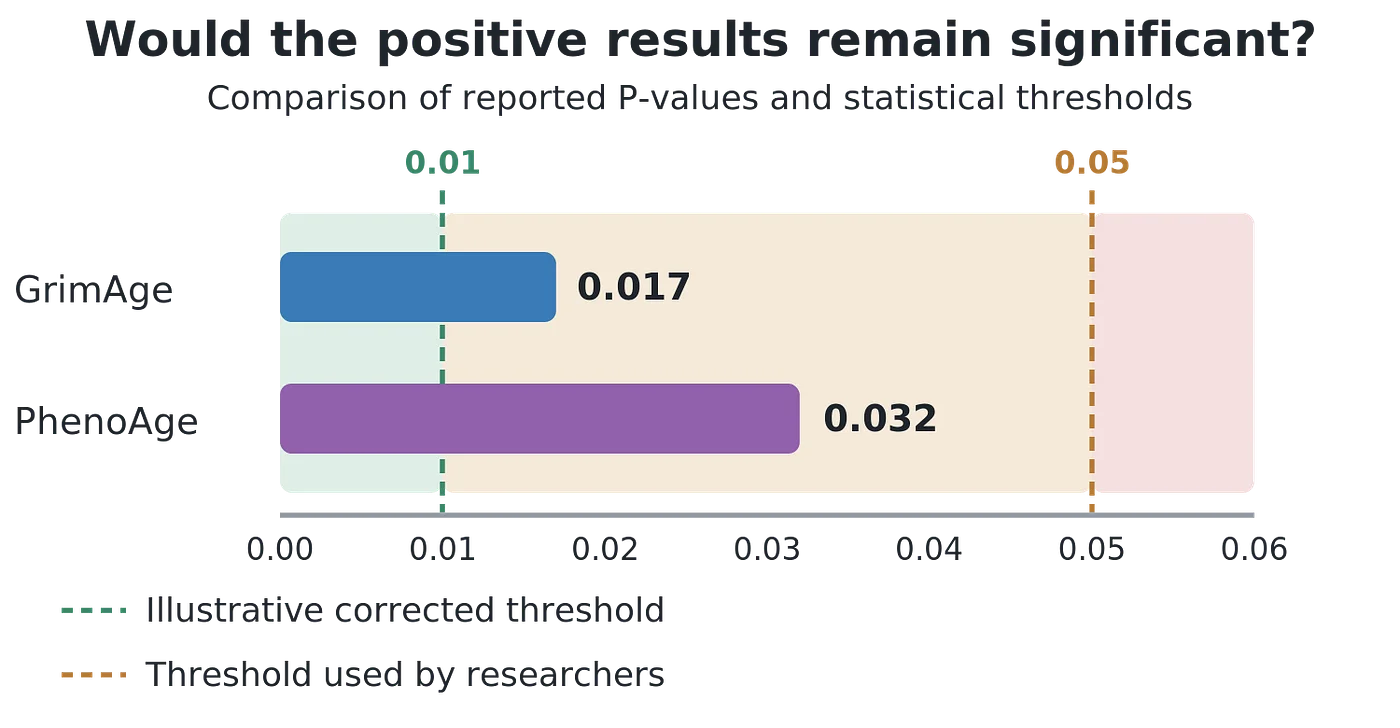
The researchers did not apply such an adjustment in this study. They explained that the biological aging clocks were closely related to one another and that applying corrections might make it more difficult to detect genuine improvements. Nevertheless, a simple statistical adjustment known as the Bonferroni correction illustrates why this issue matters. If the usual significance threshold of 0.05 were divided by the five aging clocks examined for the multivitamin, the new threshold would be 0.01. Table 3 compares the reported results with both statistical thresholds.

Biological aging clock Reported P-value Below 0.05 Below 0.01
Horvath 0.731 No No
Hannum 0.405 No No
PhenoAge 0.032 Yes No
GrimAge 0.017 Yes No
DunedinPACE 0.191 No No

Table 3. Reported statistical results compared with an illustrative Bonferroni correction across the five multivitamin aging-clock measurements.

As shown in Figure 5, neither of the two positive results would remain statistically significant under this particular correction.

Figure 5. Neither positive result meets the more conservative threshold of 0.01 in this illustrative statistical comparison.

This does not prove that the results are false. The Bonferroni correction can be overly conservative when measurements are closely related, as they were in this study. However, it does demonstrate that the statistical evidence is less convincing when a stricter threshold is applied. The possibility that some of these findings occurred by chance cannot be dismissed.

Why Were People Who Developed Serious Diseases Excluded?

Another important detail is how the researchers selected the participants for this particular investigation. They wanted to examine biological aging among generally healthy older adults. To do this, they selected people who were free of major chronic conditions at the beginning of the study and who did not experience certain cardiovascular events or develop invasive cancer during a period that extended beyond the blood collection period. Their reasoning was that developing a serious disease could influence the results of the biological aging tests.

That is understandable. However, excluding people based on health events that occurred after they were originally assigned to their treatment groups can also create problems when interpreting the results. If the purpose of studying biological aging is ultimately to understand whether people can remain healthier for longer, then knowing what happened to the people who developed serious diseases is also important. Did their biological aging clocks predict what happened to them? Did taking a multivitamin influence their chances of developing those diseases? Were changes in their aging-clock readings connected to their actual health?

This particular investigation was not designed to answer those questions.

Can a Blood Test Tell Us How Our Entire Body Is Aging?

All five biological aging clocks in this investigation were calculated using DNA obtained from blood samples. Our blood can provide a considerable amount of information about our health. Blood tests can help identify nutritional problems, inflammation, difficulties controlling blood sugar and many other conditions that may affect how well our bodies function.

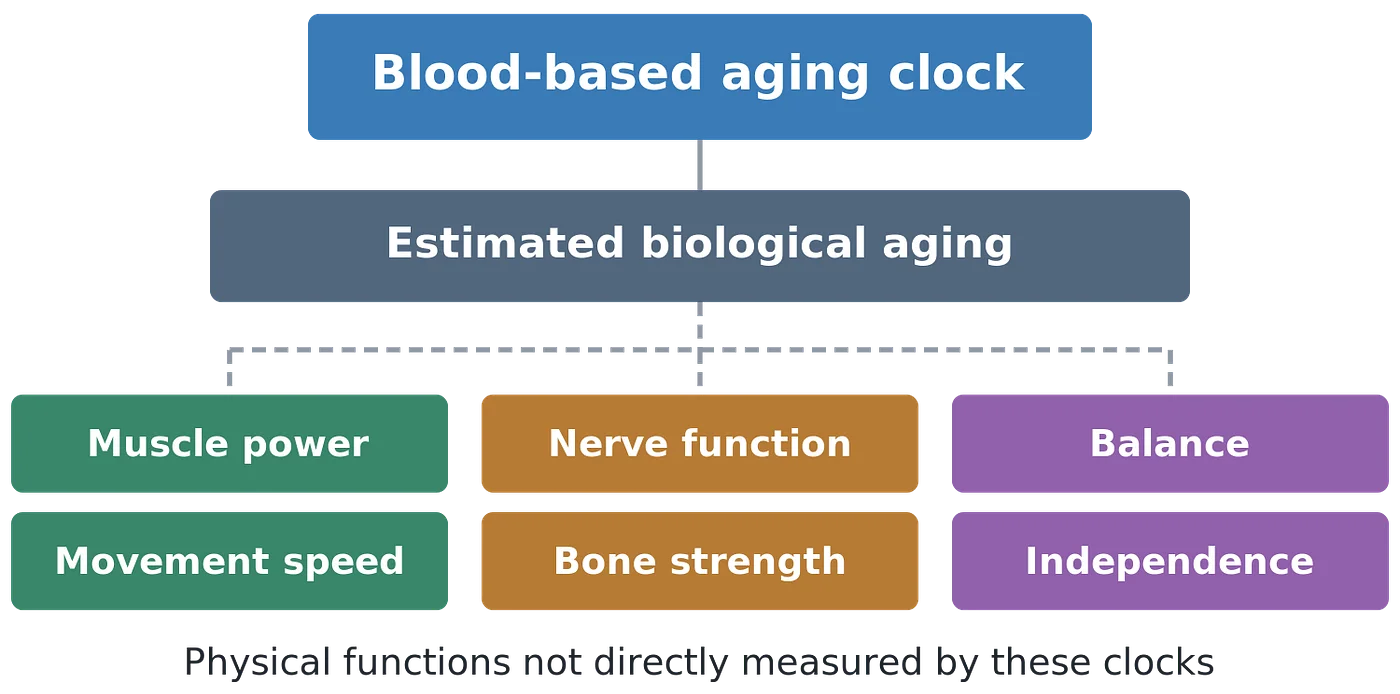
However, the human body is made up of many different organs, tissues and biological systems. They do not necessarily deteriorate at the same speed. A blood-based aging clock does not directly measure how quickly someone is losing muscle power, how well their nervous system controls their movements or how effectively they can maintain their balance. It does not directly measure how rapidly their bones are weakening, how much flexibility they are losing or how well they can respond to sudden changes in their surroundings. These are important aspects of growing older because they influence whether someone can continue living independently. Figure 6 illustrates several of these physical abilities that are not directly measured by blood-based aging clocks.

Figure 6. Blood-based biological aging clocks do not directly measure many of the physical abilities that influence how well people function as they grow older.

The researchers themselves acknowledge that current biological aging clocks do not capture all the changes that occur throughout the human body during aging. Until we establish that improving these readings also helps preserve the body's ability to function, we should be careful about interpreting changes in biological aging scores as proof that the entire body is aging more slowly.

Funding and Conflicts of Interest

Scientific research often requires considerable financial support, particularly when it involves hundreds or thousands of participants, repeated blood tests and expensive laboratory equipment. Commercial companies frequently provide some of that support. This does not automatically mean that the research is unreliable, but readers should be aware of the relationships between researchers and companies that may have a financial interest in the findings.

Several such relationships were disclosed on the first page of this scientific paper. Mars Edge, a division of Mars Incorporated involved in nutrition research and products, provided research grants for infrastructure support and donated study pills and packaging. Pfizer Consumer Healthcare, now Haleon, also donated study pills and packaging. The multivitamin examined in the study was Centrum Silver, supplied by Pfizer Consumer Healthcare. The cocoa extract was supplied by Mars Edge.

Another particularly relevant company was FOXO Technologies, which provided support for generating and preparing the DNA methylation data used in the biological aging investigation. One of the researchers was also a former employee of FOXO Technologies. These and other disclosed relationships are presented in Table 4.

Company or organization Relationship disclosed in the paper
Mars Edge Research grants, infrastructure support, study pills and packaging
Pfizer Consumer Healthcare Study pills and packaging
Haleon Research grants, lecture payments and/or travel support
FOXO Technologies Research grants, DNA methylation data support and former employment of an author
Pure Encapsulations Research grants to an author
American Pistachio Growers Research grants to an author
BASF Lecture payments and/or travel support
Council for Responsible Nutrition Lecture payments and/or travel support
Massachusetts Life Sciences Center Research grants to an author

Table 4. Selected commercial and organizational relationships disclosed in the scientific paper. Not all relationships represent direct funding of this particular investigation.

The researchers also disclosed individual relationships. JoAnn E. Manson and Howard D. Sesso received investigator-initiated grants from Mars Edge and donations of study materials from Pfizer Consumer Healthcare. Howard D. Sesso disclosed additional research grants from several organizations, including FOXO Technologies, Pure Encapsulations and Haleon, as well as payments and/or travel support for lectures from several organizations. Pamela M. Rist disclosed donations of study pills and packaging from Mars Edge for another research trial funded by the National Institutes of Health. Brian H. Chen was formerly employed by FOXO Technologies.

These relationships were openly disclosed in the scientific paper. They are not evidence that the researchers manipulated their findings or that the companies influenced the conclusions. Nevertheless, when a study examines commercial supplements using biological aging measurements supported by a company involved in that field, readers deserve to know about these relationships when evaluating the results.

What the Researchers Themselves Acknowledge

Despite the positive findings reported for two of the biological aging clocks, the researchers acknowledge several important limitations. They recognize that the improvements were small, that the biological aging tests do not capture everything that happens during aging and that further research is needed to establish whether changes in these measurements lead to meaningful improvements in human health. They also acknowledge that the study lasted only two years and involved predominantly older white adults. Whether similar results would occur in younger people or other populations remains uncertain.

The researchers suggest that taking a multivitamin could potentially provide greater benefits to people who have inadequate nutritional intake. This is an interesting possibility that deserves further investigation. However, the study does not establish that taking a daily multivitamin will extend human lifespan or preserve the body's overall ability to function as we grow older.

My Perspective

There is no magic pill, no magic food and no modern-day ambrosia that will protect us from aging. For decades, millions of people have taken multivitamins, consumed cocoa and eaten foods that are now being promoted for their potential longevity benefits. Yet people have continued to grow old, become frail, develop diseases and die.

So what exactly are we searching for?

I am not questioning the importance of vitamins, minerals or nutritious foods. Our bodies need these things to remain healthy, and correcting a nutritional deficiency can certainly improve someone's health. But there is a considerable difference between improving someone's health and slowing down the aging process itself. If taking a multivitamin changes the reading on a biological aging clock, does that mean the person will remain physically capable for longer? Will they retain their strength, speed, balance and ability to move independently as they grow older? Will they live longer? These are the questions that need answering.

We must be careful not to confuse a small improvement in a number calculated from a blood sample with a meaningful change in how the entire human body ages. Rather than continuing to search for a miracle substance, perhaps we should pay more attention to what actually deteriorates in the human body as we grow older and what we can do to preserve it.

Conclusion

The COSMOS investigation provides some evidence that taking a daily multivitamin may slightly influence certain biological aging measurements in older adults. However, only two of the five biological aging clocks showed statistically significant improvements, and the size of those improvements was extremely small. Cocoa extract failed to produce significant improvements in any of the five aging clocks. The absence of statistical adjustments for multiple comparisons, the limitations of blood-based biological aging measurements and the lack of demonstrated long-term health benefits associated with these changes all need to be considered when interpreting the findings. The commercial relationships disclosed in the paper also deserve attention, although they do not automatically invalidate the research.

Multivitamins can play an important role in helping people obtain essential nutrients, particularly when their diets do not provide adequate amounts. Cocoa and other nutritious foods may also provide valuable health benefits. But demonstrating that a substance supports good health is not the same as demonstrating that it slows human aging.

Until further research establishes that these small changes in biological aging scores translate into meaningful improvements in how long and how well people live, the findings should be interpreted with appropriate caution.

Reference

Li, S., Hamaya, R., Zhu, H., Chen, B. H., Pereira, A. C., Ivey, K. L., Rist, P. M., Manson, J. E., Dong, Y., & Sesso, H. D. (2026). Effects of daily multivitamin–multimineral and cocoa extract supplementation on epigenetic aging clocks in the COSMOS randomized clinical trial. Nature Medicine, 32, 1012–1022.

https://doi.org/10.1038/s41591-026-04239-3