New Study Models the Limits of Human Lifespan — But Where Are the Motor Units?
By Tony Ruggia | I AM LONGEVITY | Longevity News | November 25, 2026
A new study published in npj Aging examines how long humans could theoretically live if scientists managed to eliminate all the major causes of aging except for changes that accumulate in our DNA. According to the researchers, these changes alone could limit the median human lifespan to between 146 and 194 years, meaning that half the population could theoretically survive to somewhere between these ages.
However, there is something missing from this study that I believe is extremely important. The researchers examined the brain, heart, liver and lungs, yet they left out the motor units that control our muscles, including the muscle that allows us to breathe.
What Did the Study Find?
Throughout our lives, small changes occur in the DNA of our cells. Scientists call these changes somatic mutations. As they accumulate, some cells may stop working properly, while others may die. The researchers wanted to find out how long humans could live if these changes were the only remaining cause of aging. To do this, they created a mathematical model based on four major organs: the brain, heart, liver and lungs.
Here is what their calculations showed:
- Without biological aging, and assuming we maintained the same risk of dying as a 30-year-old throughout life, half the population could theoretically survive to 1,759 years.
- When the researchers included cell death caused by DNA mutations, this number dropped to 156 years.
- Depending on how they calculated the risks of organ failure, the median lifespan ranged from 146 to 194 years.
- The estimated maximum lifespan ranged from 210 to 557 years.
Of course, these are mathematical estimates. Nobody has demonstrated that humans can actually live this long.
Why Some Cells Are More Difficult to Replace Than Others
One of the most interesting points raised in this study is that our bodies can replace certain types of cells much more easily than others. Take the liver, for example. When liver cells die, other cells can multiply to replace them. This allows the liver to repair itself and continue functioning. Unfortunately, the same cannot be said for most nerve cells or heart muscle cells. Once these cells die, our bodies have very little ability to replace them. The researchers believe that the gradual loss of these cells could eventually prevent humans from living much longer, even if scientists managed to eliminate other causes of aging. (Efimov et al., 2026)
This brings me to an important question.
Where Are the Motor Units?
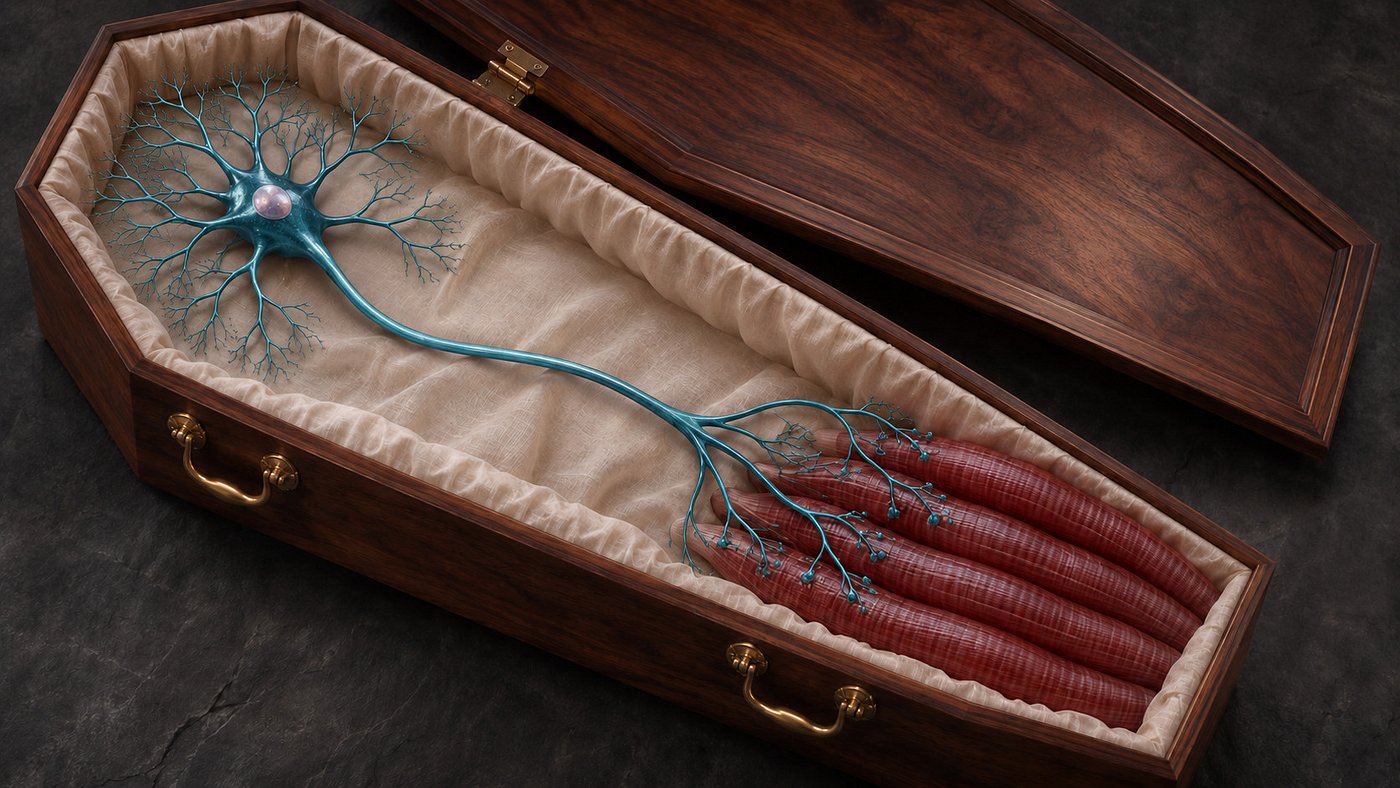
For those unfamiliar with motor units, a motor unit consists of a nerve cell called a motor neuron and a group of muscle fibers controlled by that nerve cell. When the nerve cell sends an electrical signal to those muscle fibers, they contract. Every time you walk, run, lift something or take a breath, you depend on motor units. (Piasecki et al., 2016)
We have known for more than 50 years that humans gradually lose motor units as they age. In a study published in 1973, researchers examined a small muscle in the foot responsible for straightening the toes. They found that some of the oldest people examined had fewer than 10% of the motor units found in younger people. Since then, researchers have discovered that this problem is not limited to the muscles in our feet. Motor unit loss occurs in other muscles throughout the body, although the speed at which we lose them varies from one muscle to another. (Piasecki et al., 2016)
What makes this particularly concerning is how early in life this process may begin. Research published in 1997 by Roos et al. examined how motor units deteriorate as we age. In a scientific review published in 2006 by Figueiredo et al., the researchers reported that we begin losing muscle fibers at approximately 25 years of age. They also discussed evidence suggesting that we begin losing motor units during our twenties at a rate of approximately 1% per year, with the loss becoming considerably faster after the age of 60.
Further evidence came from a study published in 2016 by Piasecki et al.. The researchers examined one of the large muscles in the thigh and found that older men, averaging approximately 71 years of age, had an estimated 50–60% fewer motor units than younger men after taking differences in muscle size into account.
Now, here is something extremely important to understand. Unlike many other cells in our bodies, mature motor neurons cannot normally divide to produce new motor neurons. Scientists describe these cells as terminally differentiated or post-mitotic. What this means in everyday language is that when a motor neuron dies, the body cannot simply produce another one to take its place. Other surviving motor neurons may take over some of the muscle fibers that have lost their nerve supply, but this does not replace the motor neuron that has died. (Piasecki et al., 2016)
Considering that we may begin losing motor units during our twenties at a rate of approximately 1% per year, and that this loss becomes faster after the age of 60, as reported by Figueiredo et al. (2006), it is my hypothesis that somewhere around the age of 120, we may no longer have enough functioning motor units to survive.
Why? Because we need motor units to breathe.
The diaphragm is a large muscle located underneath our lungs. When it contracts, it moves downward, allowing air to enter our lungs. Like other muscles in our bodies, the diaphragm depends on nerve cells to tell it when to contract. These nerve cells send electrical signals through nerves called the phrenic nerves. If we eventually lose too many of the motor units controlling the diaphragm, the muscle may no longer be capable of contracting strongly enough to keep us breathing adequately.
You could have perfectly healthy lungs, but what good are healthy lungs if you cannot breathe?
This is why I question the decision to leave motor units out of a study investigating the upper limits of human lifespan. The researchers calculated how long our lungs, heart, brain and liver could theoretically survive, but they did not calculate how long we could maintain enough functioning motor units to continue breathing. It is my hypothesis that we could reach this limit at approximately 120 years of age, long before the organs examined in this study reach their predicted failure points.
Conclusion
While I find this study interesting, I believe that any attempt to calculate the maximum human lifespan should also take into account the gradual loss of motor units. We have decades of scientific research showing that humans lose a substantial number of these units as they age. We also know that the diaphragm depends on motor units to function. What we still need to establish is how many motor units we lose in the diaphragm throughout our lives and how many we need to remain alive. Until we have those answers, I believe we are overlooking a potentially important reason why humans rarely live beyond 120 years.
We can talk about living to 150, 200 or even 500 years, but there is one very simple question that needs to be answered first.
Will we still have enough functioning motor units to breathe?
References
1. Efimov et al. (2026)
Somatic mutations impose an entropic upper bound on human lifespan. npj Aging, 12, 116.
DOI: 10.1038/s41514-026-00421-6
2. Campbell, McComas and Petito (1973)
Physiological changes in ageing muscles. Journal of Neurology, Neurosurgery & Psychiatry, 36(2), 174–182.
DOI: 10.1136/jnnp.36.2.174
3. Roos, Rice and Vandervoort (1997)
Age-related changes in motor unit function. Muscle & Nerve, 20(6), 679–690.
Original publication: PubMed
4. Figueiredo et al. (2006)
Ceasing of muscle function with aging: Is it the consequence of intrinsic muscle degeneration or a secondary effect of neuronal impairments? European Review of Aging and Physical Activity, 3, 75–83.
DOI: 10.1007/s11556-006-0011-9
5. Piasecki et al. (2016)
Age-related neuromuscular changes affecting human vastus lateralis. The Journal of Physiology, 594(16), 4525–4536.
DOI: 10.1113/JP271087
6. Piasecki et al. (2016)
Age-dependent motor unit remodelling in human limb muscles. Biogerontology, 17, 485–496.
DOI: 10.1007/s10522-015-9627-3