Apigenin and Longevity: Can This Natural Compound Slow Aging?
By Tony Ruggia | I AM LONGEVITY | Nutrition | November 25, 2026
A scientific review published in Bioactive Compounds in Health and Disease takes a closer look at apigenin, a natural substance found in many fruits, vegetables and herbs. Researchers are particularly interested in its ability to reduce the damage caused by aging cells and help protect an important molecule called NAD⁺, which our bodies need to produce energy and repair damage.
The good news is that you don’t necessarily need to buy a supplement to obtain apigenin.
What Are Zombie Cells?
When certain cells in your body become damaged, they stop dividing. Normally, damaged cells can be removed by the body, but some manage to stay alive. These are known as senescent cells, or what many people call zombie cells. As we grow older, more of these cells can accumulate throughout the body. What makes them particularly troublesome is that they can release harmful substances that cause inflammation, damage nearby healthy cells and interfere with the normal functioning of our tissues and organs.
Scientists have been looking for ways to deal with these cells for years.
Some researchers are investigating substances that can kill zombie cells, while others are looking at ways to stop them from releasing harmful substances. Apigenin appears to be particularly promising in the second area.
Can Apigenin Kill Zombie Cells?
According to the researchers, there is currently no clear evidence that apigenin can selectively kill zombie cells.
What laboratory experiments have shown, however, is that apigenin can reduce the amount of harmful substances these cells release. Think of a damaged cell that continues to release inflammatory substances into its surroundings. Even if you cannot remove that cell, reducing the amount of harmful substances it produces could help protect the healthy cells around it. This is what makes apigenin interesting. It appears to change the behavior of these damaged cells rather than destroy them.
The researchers also discuss experiments in which apigenin caused cancer cells to die. However, they make it clear that killing cancer cells does not necessarily mean that apigenin can kill zombie cells.
More research is needed to answer that question.
How Apigenin May Help Protect NAD⁺
If you follow longevity research, you have probably heard of NAD⁺. It is a molecule found throughout the body that helps our cells produce energy, repair damaged DNA and carry out many of their everyday functions. As we grow older, the amount of NAD⁺ available to our cells tends to decline.
But why does it decline?
One of the reasons involves an enzyme called CD38, which breaks down NAD⁺. Research suggests that as we age, increased CD38 activity contributes to the loss of NAD⁺. This has led scientists to investigate whether slowing down its breakdown could help maintain healthier levels.
Most people interested in increasing their NAD⁺ levels have probably heard of supplements such as NMN and NR. These provide the body with materials it can use to make NAD⁺. Apigenin takes a different approach. Rather than supplying the body with more of these materials, it may help protect the NAD⁺ that is already there by slowing down the activity of CD38.
The review discusses experiments in diabetic rats in which apigenin increased NAD⁺ levels and helped reduce kidney damage. Although these findings are encouraging, we still need human studies to determine whether consuming apigenin produces similar results in people.
Can Apigenin Reduce Inflammation as We Age?
Inflammation is not always a bad thing. When you cut your finger, for example, the area may become red and swollen as your body works to repair the damage and protect you against infection. Once the injury heals, the inflammation normally goes away.
The problem begins when inflammation doesn’t go away.
As we get older, low levels of inflammation can persist throughout the body for years. This has been linked to heart disease, diabetes, muscle loss and several other health problems associated with aging. The researchers examined experiments in which apigenin reduced the production of several substances that promote inflammation. They also found evidence that apigenin may help protect cells against damage caused by highly reactive molecules known as free radicals. Much of this research, however, has been carried out in laboratory experiments and animals rather than humans.
Could Apigenin Help You Sleep Better?
Chamomile tea has long been associated with relaxation and better sleep. Interestingly, chamomile naturally contains apigenin.
The researchers discuss animal experiments suggesting that apigenin may influence some of the chemical signals in the brain that help us relax. Other experiments suggest that it may help protect brain cells against damage. While these findings could partly explain why chamomile has traditionally been used to promote sleep, more research is needed to determine how much apigenin is needed and whether taking apigenin on its own can significantly improve sleep in humans.
The Problem With Apigenin: How Much Does Your Body Actually Absorb?
You can consume a large amount of a natural substance without necessarily absorbing very much of it.
This is one of the biggest problems with apigenin. It does not dissolve easily in water, and much of it is broken down or changed by the digestive system and liver. In one experiment involving rats, less than 1% of the apigenin consumed reached the bloodstream in its original form. That does not mean the same percentage applies to humans, but it illustrates why researchers are concerned about how much apigenin actually becomes available to the body after we consume it.
Interestingly, the review also discusses an experiment involving humans who consumed parsley. Researchers measured the highest blood level of a form of apigenin four hours after a parsley drink, and six hours after parsley powder was consumed with yogurt. This confirms that the human body can absorb and process apigenin from parsley, although it does not tell us how much is needed to produce the potential health benefits discussed in the review.
Scientists are currently investigating different ways of improving apigenin absorption, including new methods of preparing supplements.
Can Apigenin Interfere With Medications?
The researchers warn that apigenin may interfere with some of the enzymes our bodies use to break down medications. This could cause certain medications to remain in the bloodstream longer than intended.
Anyone taking medication should speak with their doctor before taking apigenin supplements or consuming unusually large amounts of apigenin-rich foods.
Has Apigenin Been Proven to Slow Human Aging?
Not yet.
Although the findings discussed in the review are interesting, there is a considerable difference between showing that a substance protects cells in a laboratory and demonstrating that it can help humans remain healthy for longer. The researchers themselves acknowledge that we still lack reliable ways of measuring whether apigenin reduces the harmful activity of zombie cells inside the human body. We also do not know what daily amount would be needed to produce meaningful benefits or whether taking large amounts over many years would be safe.
These are questions that future human studies will need to answer.
How to Obtain Apigenin Naturally Without Supplements
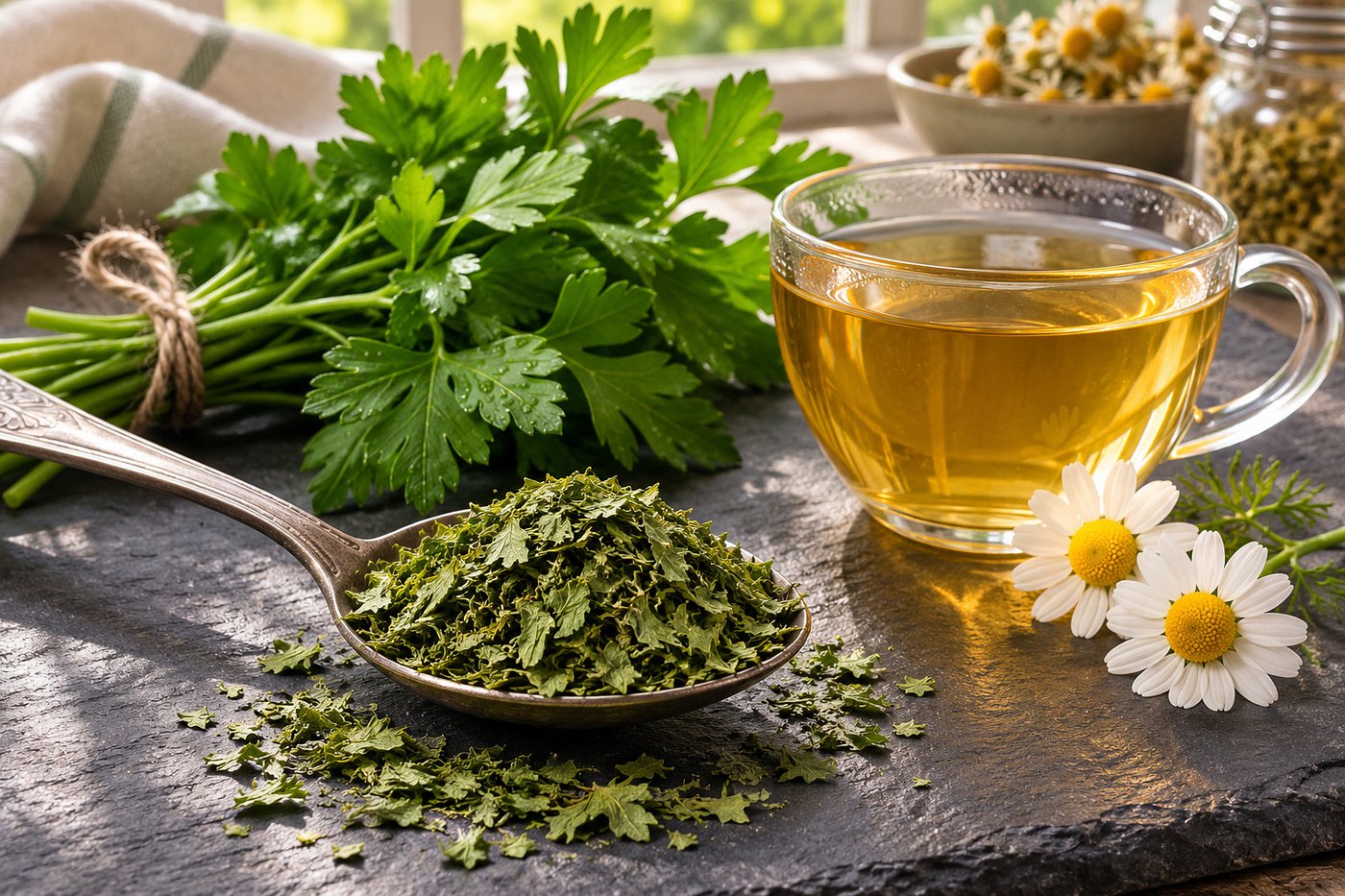
For anyone wishing to obtain apigenin naturally, one of the best and cheapest sources is dried parsley.
A separate scientific review published in 2023 in the journal Nutrients provides a remarkable comparison between the amount of apigenin found in dried parsley and fresh parsley. According to the figures presented in the paper, dried parsley contains nearly 21 times more apigenin than fresh parsley when comparing equal weights.
| Food | Apigenin per 100 grams |
|---|---|
| Dried parsley | 4,503.50 mg |
| Fresh parsley | 215.46 mg |
| Celery seeds | 78.65 mg |
| Fresh celery | 19.10 mg |
Table 1. Reported apigenin content of selected foods, based on data presented in the 2023 review.
Based on these figures, just one gram of dried parsley contains approximately 45 milligrams of apigenin, although the actual amount can vary from one product to another.
Dried parsley is inexpensive, readily available and easy to add to everyday meals. It can be sprinkled over fish, vegetables, salads, soups and many other foods. For anyone interested in obtaining apigenin naturally, there is no need to overlook something as simple as dried parsley in favor of an expensive supplement.
Can You Improve Apigenin Absorption?
Interestingly, obtaining apigenin from natural food sources may offer an advantage over taking it in supplement form.
A small human study published in 2022 compared how the body processes apigenin from capsules, parsley and chamomile tea. Researchers measured the substances produced as the body processed apigenin and found that the amounts recovered in urine differed considerably depending on the source.
| Source | Percentage recovered in urine |
|---|---|
| Pure apigenin capsule | 0.5% |
| Parsley drink | 11.2% |
| Chamomile tea | 34% |
Table 2. Percentage of intake recovered as measured apigenin metabolites in urine.
Although these percentages do not tell us exactly how much apigenin the body absorbed, they suggest that the natural form in which apigenin occurs in plants may make a considerable difference.
What about adding black pepper? Black pepper contains a substance called piperine, which may help improve the availability of certain plant compounds. However, whether adding black pepper to dried parsley specifically improves apigenin absorption in humans has yet to be established.
For now, dried parsley remains an inexpensive and exceptionally rich natural source of apigenin.
Funding and Conflicts of Interest
The authors of the 2026 review declared no conflicts of interest and received no funding for their research. The 2022 human absorption study was funded by an unrestricted gift from Mars Inc.
Conclusion
Apigenin is an interesting natural substance that may help reduce some of the damage caused by aging cells. Its ability to slow down the breakdown of NAD⁺ in experimental research is another reason why it deserves attention in longevity research. However, much of the evidence comes from laboratory and animal experiments, and it has not yet been demonstrated that consuming apigenin can slow human aging or extend human lifespan.
For those wishing to include more apigenin in their diet, dried parsley offers a simple, natural and inexpensive option.
References
1. Chaiyasit, K., Likitkriengkri, K., Muangsri, K., & Srisukthaveerat, V. (2026). Apigenin as a bioactive compound for longevity: Targets and mechanisms in senescent cells. Bioactive Compounds in Health and Disease, 9(3), 131–147. DOI: 10.31989/bchd.v9i3.1929
2. Thomas, S. D., Jha, N. K., Jha, S. K., Sadek, B., & Ojha, S. (2023). Pharmacological and Molecular Insight on the Cardioprotective Role of Apigenin. Nutrients, 15(2), 385. DOI: 10.3390/nu15020385
3. Borges, G., Fong, R. Y., Ensunsa, J. L., Kimball, J., Medici, V., Ottaviani, J. I., & Crozier, A. (2022). Absorption, distribution, metabolism and excretion of apigenin and its glycosides in healthy male adults. Free Radical Biology and Medicine, 185, 90–96. DOI: 10.1016/j.freeradbiomed.2022.04.007