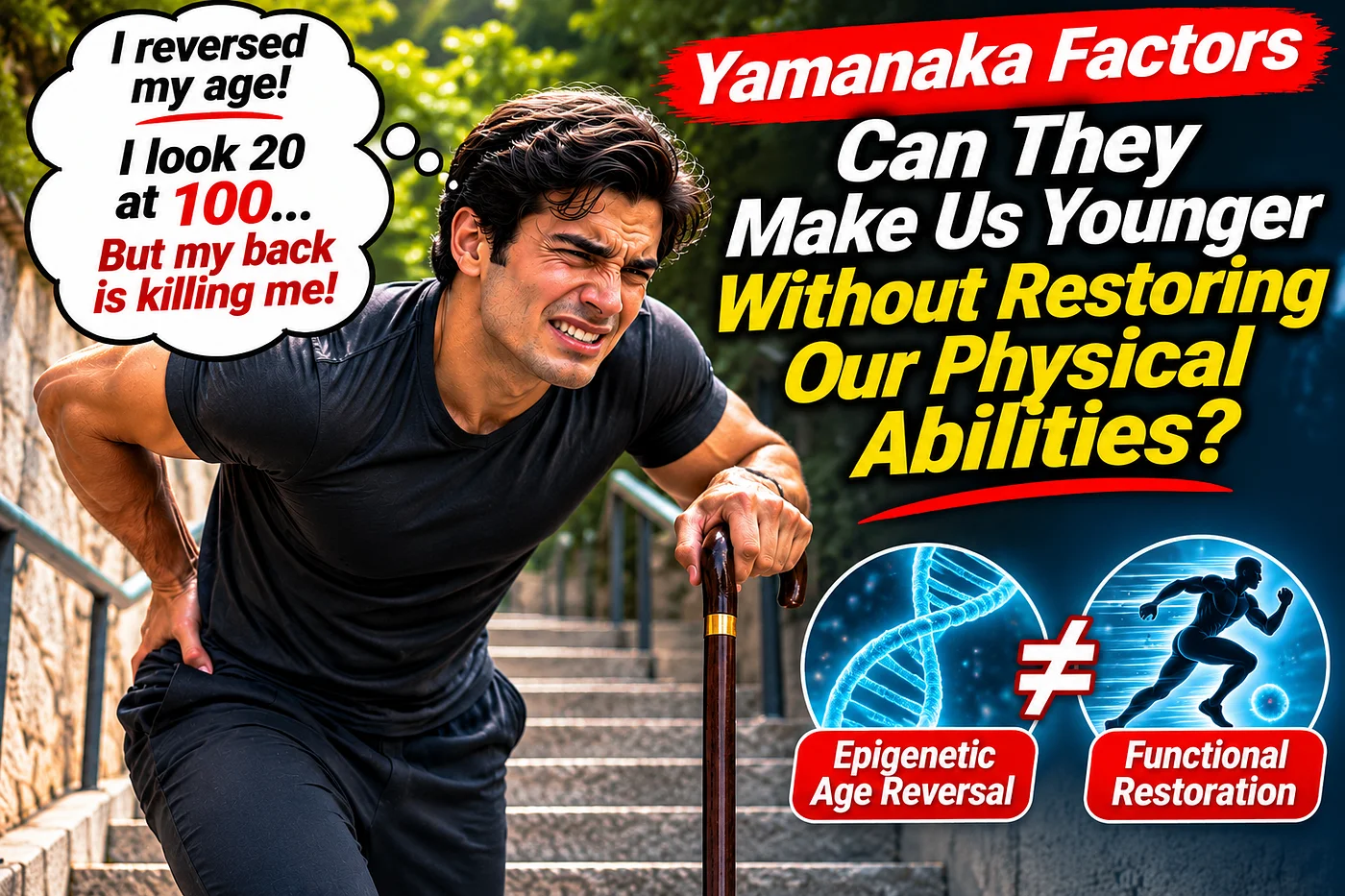
Can Yamanaka Factors Make Us Younger Without Restoring Our Physical Abilities?
By Tony Ruggia | I AM LONGEVITY | November 27, 2026

Imagine reaching 100 years of age with the appearance of a 20-year-old. You have youthful skin, dark hair and a biological age test suggesting that you have reversed decades of aging. However, you still need a cane to walk, your back hurts, and climbing a flight of stairs leaves you exhausted. Have you really become younger?
A new systematic review and meta-analysis by Ming Yao, published in 2026, examines this very important distinction between reversing biological age markers and restoring the body’s ability to function.
What Are Yamanaka Factors?
Yamanaka factors are four proteins known as Oct4, Sox2, Klf4 and c-Myc. Scientists can use these proteins to change how cells operate and reset certain molecular features associated with aging. Through a process called partial cellular reprogramming, researchers attempt to make cells biologically younger without causing them to lose their original identity.
It is an exciting area of research. However, making individual cells younger and restoring the youthful abilities of an entire human body are two very different challenges.
What Did the New Scientific Review Discover?
The review examined 14 studies involving 274 mice. The primary statistical analysis included 10 studies involving 198 animals. The relationship between reversing epigenetic age and improving overall physical and physiological function was remarkably weak. Changes in epigenetic age explained less than 1% of the variation in functional outcomes.
As shown in Table 1, the review found no statistically significant overall improvements in muscle strength and motor performance, metabolic function or cognitive performance.
| Function examined | Statistically significant overall improvement? |
|---|---|
| Muscle strength and motor performance | No |
| Metabolic function | No |
| Cognitive performance | No |
| Certain tissue-specific functions | Yes |
Some experiments demonstrated improvements in specific tissues, particularly cells involved in vision and memory. These are important findings, but they do not demonstrate that an entire aging organism has regained its youthful abilities.
The Damage That Remains Behind
The author introduces a concept called the damage shadow. The idea is relatively simple. Throughout life, the body accumulates different forms of damage that may remain even after the molecular markers of aging have been reversed. These include changes to collagen, damage to mitochondrial DNA and the accumulation of damaged proteins.
Resetting an epigenetic clock does not necessarily remove these problems. But there is another important question that deserves attention. What happens to our motor units?
Can Yamanaka Factors Restore Youthful Movement?
Every movement you make depends on communication between your nervous system and your muscles. Running, jumping, maintaining balance and even breathing depend on this communication.
As we age, the ability of the nervous system to activate muscles rapidly can deteriorate. This involves several mechanisms, including descending neural drive, persistent inward currents, motor neuron firing frequencies and the recruitment of fast motor units. Making a muscle cell biologically younger does not automatically demonstrate that these mechanisms have been restored.
Where is the evidence that partial cellular reprogramming can return these mechanisms to their youthful levels? The new review did not directly investigate these specific neuromuscular mechanisms. However, its failure to establish significant overall improvements in motor performance raises an important question about the limitations of current reprogramming approaches.
My Perspective
If scientists eventually develop a treatment that makes a 100-year-old person biologically resemble a 20-year-old, I want to see that person move. Can they sprint? Can they jump? Can they rapidly change direction? Can they generate explosive muscular force and maintain their balance? These are questions that an epigenetic clock cannot answer.
I am not suggesting that Yamanaka factors have no therapeutic potential. I am questioning whether resetting the biological age of our cells is sufficient to restore the youthful function of the human body. This distinction is central to my neuromuscular theory of aging.
Looking younger is not the same as moving younger. And reversing a biological age marker is not necessarily the same as reversing aging itself.
Related Articles
- Biological Age Tests: New Study Raises Questions Over Conflicts of Interest
- Does Thymic Involution Cause Motor Unit Deterioration?
- Tetz’s Law of Longevity: What Happens When Motor Units Enter the Equation?
Scientific Reference
1. Yao, M. (2026). Epigenomic Rejuvenation Without Functional Restoration: A Systematic Review and Meta-Analysis of the Disconnect Between DNAm Age Reversal and Physiological Improvement. Longevity Horizon, 2(5). https://doi.org/10.65649/n15sg225