Muscle Aging Begins Long Before Sarcopenia — Are We Overlooking the Early Warning Signs?
By Tony Ruggia | I AM LONGEVITY | Longevity News | November 25, 2026
A new scientific review, published on October 5, 2026, in the journal Cureus, suggests that we may be waiting far too long to address the deterioration of our muscles. Although most people associate muscle loss with old age, the ability of our muscles to perform can begin to decline many years before we notice any significant loss of muscle. The researchers believe that the years between 40 and 64 represent an important opportunity to address these changes before they become serious problems.
But are we paying enough attention to what actually causes our muscles to perform poorly as we age?
Muscle Aging Is Not Just About Losing Muscle
When people talk about aging muscles, they often focus on how much muscle we lose. But having plenty of muscle does not necessarily mean that those muscles are working as well as they should. Imagine two men with roughly the same amount of muscle in their legs. One can run quickly, jump, change direction and climb stairs with ease, while the other struggles to perform those same movements. If we were to measure the amount of muscle in their legs, we might find very little difference between them. Yet the difference in what they can physically do could be enormous. This is why muscle size alone does not tell us the whole story.
The authors explain that muscle size, strength, power and quality do not all decline at the same rate. Some of these changes can begin during middle age, long before a person develops a condition known as sarcopenia, which involves the loss of muscle mass and strength. By waiting until someone has developed sarcopenia, we may have already missed years of opportunity to do something about it.
Why Muscle Power Matters as We Age
There is a difference between being strong and being powerful. Imagine lifting a heavy weight very slowly. Now imagine lifting a lighter weight as quickly as possible. Both movements require strength, but the second also requires the ability to produce force rapidly. This is closely related to what scientists call muscle power, which combines force and speed. It is particularly important in situations where you don't have much time to react. If you suddenly trip while walking down the street, for example, being able to move your leg quickly enough to stop yourself from falling can make all the difference.
The researchers explain that muscle power tends to decline earlier and more rapidly than maximum muscle strength as we age. They therefore suggest that people should consider including exercises that involve moving moderate weights quickly and safely, rather than performing all their strength exercises slowly.
However, more research is still needed to determine which approaches work best for people in their 40s, 50s and early 60s.
Why We Should Start Paying Attention During Middle Age
Most people in their 40s or 50s would not visit their doctor simply because they can no longer run as fast as they could when they were younger. They probably wouldn't mention that they can no longer jump as high or move as quickly either. These changes are generally accepted as a normal part of getting older. But what happens 20 or 30 years later? Some of those same people may begin struggling to climb stairs, get out of a chair or carry their groceries home. By that point, their physical abilities may have been declining for decades.
The authors believe that doctors should begin paying more attention to muscle health much earlier in life. They particularly recommend assessing people who experience unexplained weakness, difficulties moving, unexpected weight loss or long periods of inactivity. People living with certain health conditions may also need closer attention because these conditions can contribute to the deterioration of muscle health.
The idea is to identify problems before they become serious enough to interfere with someone's ability to live independently.
How Can We Tell if Our Muscles Are Aging?
You don't necessarily need expensive medical equipment to get a basic idea of how well someone's muscles are working. The researchers discuss several tests that could be performed in a doctor's office, some of which take only a few minutes.
| Test | What it tells us |
|---|---|
| Handgrip strength | How strongly you can squeeze an object |
| Sit-to-stand test | How quickly you can get out of a chair five times |
| Walking speed | How quickly you can walk a certain distance |
| Body composition measurements | An estimate of how much muscle you have |
| SARC-F questionnaire | Whether you have difficulties performing everyday activities |
However, these tests have their limitations, particularly when examining younger and physically active people. Someone in their 50s might have no difficulty walking, squeezing an object or getting out of a chair, yet their ability to perform fast and powerful movements may have already declined considerably. The researchers acknowledge that we still do not have enough evidence to establish exactly when doctors should begin testing otherwise healthy middle-aged adults or what results should prompt an intervention.
What Can We Do to Protect Our Muscles?
The review highlights regular resistance training as one of the most effective ways to preserve muscle health. Research involving people aged 50 and above has shown that exercise can improve not only the size of their muscles but also their strength, muscle quality and ability to perform everyday activities. Eating enough protein is also important, especially for people who are trying to lose weight. When someone goes on a diet, they may lose more than just body fat. They can also lose muscle, which is something that becomes increasingly important to avoid as we grow older. Combining adequate nutrition with resistance training can help protect against this loss.
Interestingly, the researchers found that routinely taking vitamin D supplements has not shown the same benefits for muscle health in otherwise healthy adults. This does not mean that vitamin D is unimportant, particularly for someone who has a deficiency.
The authors also point out that we need to pay special attention to what happens during periods of inactivity. Someone who spends several weeks recovering from an illness or staying in hospital may experience a decline in muscle health. Helping that person regain their physical abilities should therefore be an important part of their recovery.
Our Perspective: Sarcosthenia — Are We Looking at Muscle Aging the Wrong Way?
While the authors discuss the importance of preserving muscle power, there is another question that deserves attention: What causes us to lose that power in the first place?
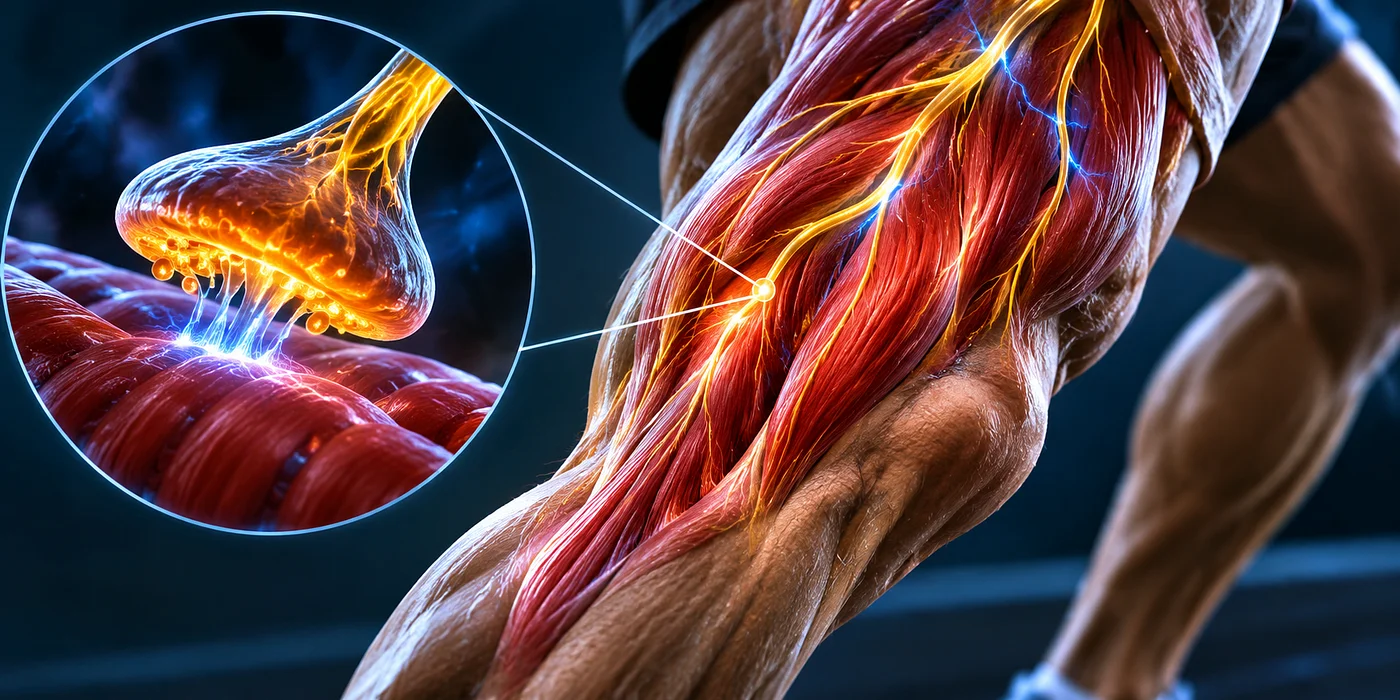
Before you can move a muscle voluntarily, it needs to receive a signal from your nervous system. Whether you are lifting a weight, running across the street or jumping over an obstacle, your muscles depend on those signals to tell them when to contract and how much force to produce. Now imagine what could happen if those signals gradually started to deteriorate as you aged. You could still have plenty of muscle, but if your nervous system could no longer activate those muscles as quickly and effectively as it once did, your ability to produce fast and powerful movements could decline. The muscles are still there. The problem may lie partly in how effectively they are being controlled.
This brings us to a term that very few people outside the scientific community have probably heard of: sarcosthenia. Most people familiar with muscle aging have heard of sarcopenia, but there are actually three different terms worth understanding.
| Term | What it means |
|---|---|
| Sarcopenia | Loss of muscle mass and strength |
| Dynapenia | Loss of strength and power |
| Sarcosthenia | Deterioration of muscle quality and its ability to produce force and power |
These are related, but they are not exactly the same thing.
A study published in 2021 examined Masters track and field athletes, including people as old as 91. The researchers wanted to understand why older athletes could no longer jump as powerfully as younger athletes. Was it simply because they had less muscle or more body fat? Although changes in body composition explained a considerable part of the decline, they could not explain everything. Even after the researchers accounted for several of these differences, age itself remained an important factor in how much power the athletes could produce. The researchers pointed to the deterioration of muscle quality, or sarcosthenia, as part of the explanation.
Another study published in 2024 examined 102 competitive weightlifters between the ages of 35 and 86. These were athletes competing in a sport that demands enormous amounts of strength and power, yet even among these athletes, jumping power declined with age. The researchers specifically recognized sarcosthenia as a separate aspect of muscle aging that, alongside muscle loss, contributes to the decline in strength and power.
Older Muscles Produced Only Half as Much Power
Perhaps the most interesting evidence comes from a study published in the 2026 edition of The Journal of Physiology. The researchers examined 43 men, dividing them into four groups consisting of younger athletes, older athletes, younger non-athletes and older non-athletes. They used MRI scans to measure the size and fat content of 17 different muscles in the hips and legs. They then measured how much power the men could produce when jumping.
What they discovered was remarkable. The older participants produced approximately half as much jumping power for a given amount of muscle as the younger participants. Although the older men also tended to have more fat inside their muscles, this could not explain the large difference in performance.
Relative comparison between younger and older participants
Younger participants · 100%Older participants · Approximately 50%Figure 1. Jumping power per unit of muscle volume in younger and older participants. Source: Zange et al. (2026).
As shown in Figure 1, even when the researchers took the amount of muscle into consideration, the older participants were producing considerably less power. Think about what that means. You could maintain a substantial amount of muscle as you grow older and still lose a considerable part of your ability to use it effectively. The size of your muscles is only one part of the equation.
Does Sarcosthenia Begin Before Sarcopenia?
Our hypothesis is that sarcosthenia may begin long before substantial muscle loss becomes apparent and that deterioration in the signals traveling from the nervous system to the muscles may be an important early part of this process.
In other words, the loss of power may not be the beginning of the problem. It may be the result of a problem that has already started.
When we measure how much power someone can produce, we are measuring the end result of several things working together. The nervous system must send the necessary signals, the muscles must receive those signals, and the muscle fibers must respond. If something begins to deteriorate anywhere along that chain, the amount of power a person can produce may decline, even if their muscles have not become noticeably smaller. This is why we believe that the communication between the nervous system and the muscles deserves considerably more attention in research on muscle aging. Preserving muscle mass is important, but preserving the body's ability to activate those muscles effectively may be just as important.
The three studies discussed above support the idea that muscle loss alone cannot explain the decline in physical performance as we age. However, they do not establish whether the deterioration of nerve signals is the first thing to occur or exactly when this process begins. That is a question that future research needs to address.
Funding and Conflicts of Interest
The authors of the original October 2026 scientific review declared no conflicts of interest and reported receiving no financial support for their work.
Conclusion
One of the most important messages from this new scientific review is that we should not wait until we are old to start paying attention to our muscles. Regular resistance training, adequate nutrition and exercises that help us maintain the ability to produce force quickly are all important. But preserving muscle size is not enough. We also need to understand why those muscles gradually lose their ability to perform, even when a substantial amount of muscle remains. Sarcosthenia deserves considerably more attention in longevity research, particularly when it comes to understanding how the deterioration of communication between the nervous system and the muscles may contribute to the physical decline we experience as we age.
Perhaps we should spend more time investigating what happens before we lose our power, rather than waiting until that power has already been lost.
References
1. Perez Santiago, M., Brana Miranda, R. C., Santana Mercedes, F. J., Morera Gomez, R., & Rivero Rosabales, N. (2026). Muscle Health Before Sarcopenia: A Primary Care Approach to Preserving Strength, Function, and Healthy Longevity From Midlife. Cureus, 18(10), e117480. DOI: 10.7759/cureus.117480
2. Alvero-Cruz, J. R., et al. (2021). Age-Related Decline in Vertical Jumping Performance in Masters Track and Field Athletes: Concomitant Influence of Body Composition. Frontiers in Physiology, 12, 643649. DOI: 10.3389/fphys.2021.643649
3. Riemann, B. L., et al. (2024). Countermovement Jump Peak Power Changes with Age in Masters Weightlifters. Sports, 12(9), 259. DOI: 10.3390/sports12090259
4. Zange, J., Endres, J., Clemen, C. S., & Rittweger, J. (2026). Leg and hip muscles show muscle-specific effects of ageing and sport on muscle volume and fat fraction in male Masters athletes. The Journal of Physiology, 604(2), 917–935. DOI: 10.1113/JP285665